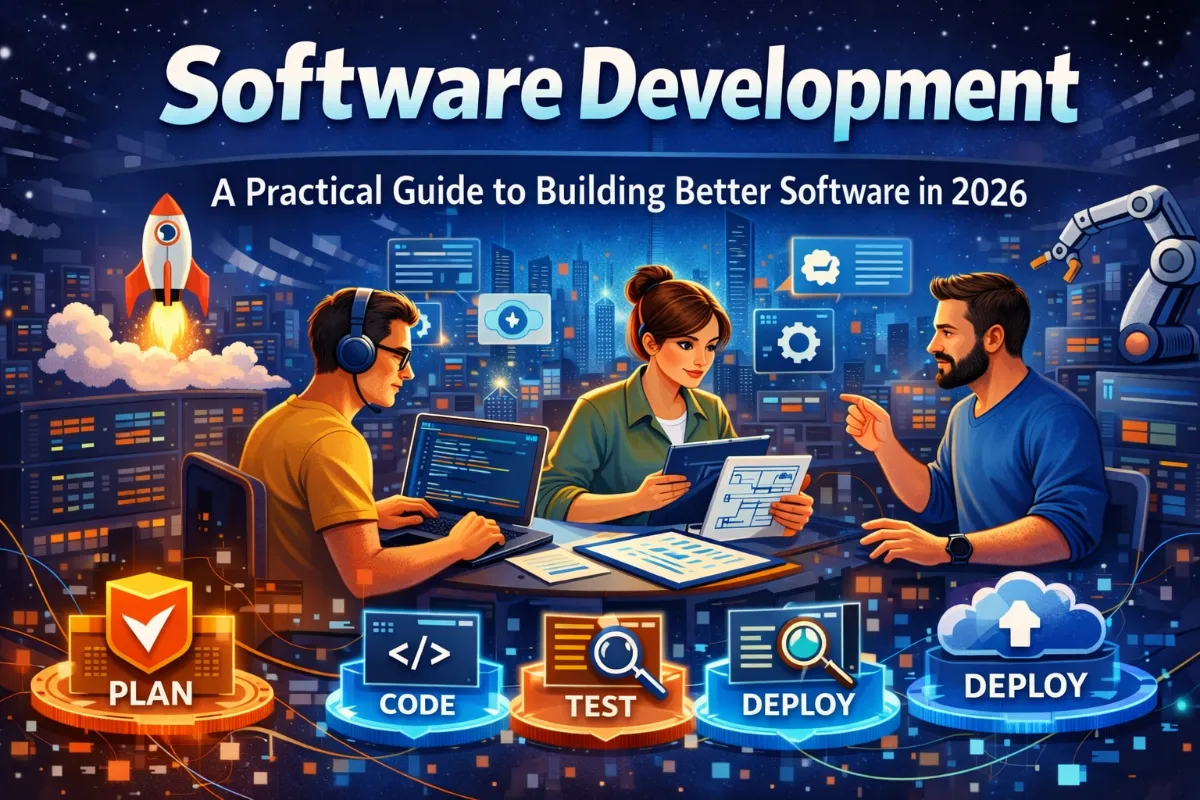
Software Development: A Practical Guide to Building Better Software in 2026
Software development is the process of designing, building, testing, and maintaining applications that solve real business problems. Whether you’re launching a startup product, modernizing an enterprise system, or building internal tools, strong development practices can reduce costs, speed up delivery, and improve user satisfaction.
In this guide, you’ll learn what software development involves today, the most common methodologies, the typical software development lifecycle (SDLC), and how to choose the right tech stack and team setup for your project.
What is software development?
At its core, software development turns an idea into a working product through planning, coding, and iteration. It includes everything from user research and UI/UX design to backend engineering, quality assurance, and post-launch support. Modern software development also includes DevOps practices, security, performance optimization, and continuous improvements based on user feedback.
Common types of software development include:
Web application development (customer portals, dashboards, SaaS platforms)
Mobile app development (iOS/Android apps, cross-platform apps)
Backend development (APIs, databases, microservices)
Cloud-native development (applications designed for scalability and resilience)
Enterprise software development (ERP integrations, internal workflows, compliance-heavy apps)
The software development lifecycle (SDLC)
A reliable SDLC helps teams deliver software faster with fewer surprises. While companies adapt it to fit their needs, most projects move through these stages:
Requirements and discovery
This stage defines what you’re building and why. Teams clarify goals, target users, key features, constraints, timelines, and success metrics. Good discovery reduces scope creep and prevents expensive rework later.Planning and architecture
Here, the team decides how the system will work: data models, API structure, infrastructure, and integration points. A solid architecture supports growth without constant rewrites.UI/UX design
Designers create wireframes and high-fidelity screens, map user flows, and ensure accessibility. Better UX reduces churn and support tickets.Development (coding)
Engineers build the frontend, backend, and integrations. Teams typically work in short iterations and deliver incremental releases to minimize risk.Testing and quality assurance
Testing verifies functionality, performance, and security. This includes unit tests, integration tests, end-to-end tests, and manual exploratory testing for edge cases.Deployment and release
The software is released to production through automated pipelines when possible. This step often involves monitoring, rollback plans, and staged rollouts.Maintenance and improvements
After launch, teams fix bugs, address security updates, optimize performance, and add new features based on feedback.
Agile vs Waterfall: which approach works best?
Choosing the right development methodology can shape timelines, costs, and outcomes.
Agile software development focuses on iterative delivery. Teams work in sprints, gather feedback quickly, and adjust priorities. Agile fits most modern product development because user needs and markets change fast.
Waterfall development follows a linear plan: requirements → design → development → testing → release. Waterfall can work for projects with fixed requirements, strict compliance, or minimal uncertainty.
Many organizations use a hybrid approach: upfront planning for core architecture and compliance, paired with Agile delivery for features.
{AD}
Essential software development best practices
High-performing teams don’t just code, they build systems that stay reliable as they grow. These best practices make a measurable difference:
Write clean, readable code, consistent naming, clear structure, and documentation for critical logic
Use version control (Git), code reviews, and branching strategies to reduce errors
Automate testing, especially unit and integration tests for core workflows
Implement CI/CD pipelines to ship faster and reduce manual deployment risk
Prioritize security, input validation, secrets management, dependency scanning, and regular patching
Monitor production, logs, metrics, uptime checks, and error tracking to catch issues early
Design for scalability, caching, database indexing, and efficient APIs to handle growth
Keep users at the center, ship small improvements, measure behavior, and iterate
Example: If you’re building an e-commerce platform, automated tests can prevent checkout bugs, monitoring can alert you to payment gateway failures, and performance tuning can improve conversion rates by reducing page load time.
Choosing the right tech stack for your project
A tech stack is the set of tools and technologies used to build an application. The “right” stack depends on your product goals, timeline, and team expertise, not hype.
Common, proven options include:
Frontend: React, Angular, Vue
Backend: Node.js, Python (Django/FastAPI), Java (Spring), .NET
Mobile: Swift, Kotlin, Flutter, React Native
Databases: PostgreSQL, MySQL, MongoDB, Redis (cache)
Cloud: AWS, Azure, Google Cloud, plus containers (Docker/Kubernetes) when needed
When selecting your stack, consider:
Time to market (how fast you can ship)
Hiring and long-term maintenance (availability of developers)
Performance needs (real-time, heavy data, high traffic)
Integration requirements (payments, CRM, analytics, legacy systems)
Security and compliance (data residency, encryption, audit logging)
In-house vs outsourcing software development
Many businesses struggle with the “build a team or hire a partner” decision. Both can work well.
In-house development is ideal when:
You need full control of product direction
Software is a core competitive advantage
You can invest in hiring, onboarding, and retention
Outsourcing software development can be ideal when:
You need to move fast with a ready team
You want predictable costs and flexible scaling
You need specialized skills (cloud, AI, security, mobile)
A popular middle ground is a dedicated development team model, where you get a consistent external team that works like an extension of your company.
What makes a software project succeed?
Software projects succeed when teams align on outcomes, not just features. Define clear business goals, prioritize the most valuable use cases, and ship in small iterations. Track metrics such as activation rate, task success rate, performance, and defect rates. Most importantly, keep feedback loops short, listen to users and improve continuously.
If you’re planning a new product, start with an MVP (minimum viable product) that proves demand, then expand features based on real usage.
Summary
Software development combines discovery, design, coding, testing, deployment, and ongoing maintenance to deliver reliable products. Using a clear SDLC, choosing the right methodology (often Agile), and following best practices like automated testing, CI/CD, monitoring, and security helps teams ship faster with fewer defects. Selecting an appropriate tech stack and the right team model (in-house, outsourced, or dedicated) improves delivery speed and long-term maintainability while keeping the focus on user outcomes.